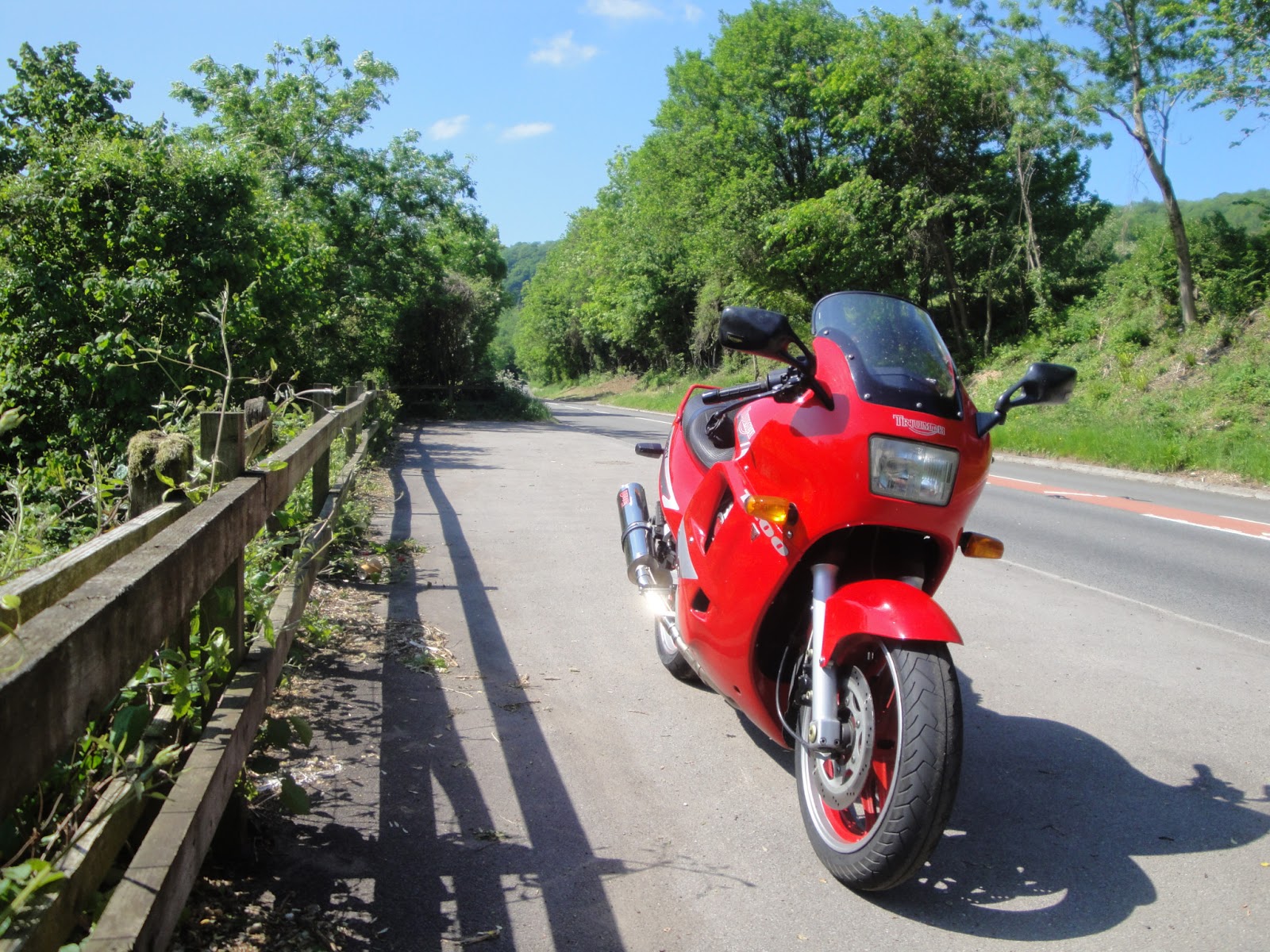
On Saturday the 8th of June 2013, I had planned to go on a BIG ride. My initial plans were thrown to the winds - nobody's fault, just one of those things. Not to worry. Nothing was going to stop me, I decided, and the fine weather forecast simply reinforced my desire to let the big Trophy have its head. Wales was beckoning to me, that marvelous land of mystery and adventure.
 |
| Scott Oiler fitted beneath RH rear panel |
The previous week, I had fitted a
Scott Oiler in preparation. I use these on all my bikes and am happy to do the wheel cleaning in return for a chain that runs smoothly over its sprockets. Whilst sealed chains have been around for years now, they do not keep lubricant around their rollers or help the sprockets in any way.
 |
| Oil changed, washed, charged, pumped up and ready to go |
I had also attempted to solve a small oil leak in the sump. The leak appeared to be coming from one of my NPT adapters. I wasn't particularly happy with this adaptor when I fitted it first time around so I had ordered a replacement
kit from Vehicle Wiring Products. This one was much meatier so I installed it without PTFE tape as before. I'd intended to use my first oil change just as a way to gently ease the bike back into service and flush out any remaining dirt so I changed it at the same time as swapping the NPT adaptor. After covering 1300 miles since my rebuild, the oil came out brown but reasonable. This time, I used Castrol fully synthetic 10w40 bike oil from Halfords. The bottle claims improved acceleration blah blah but fully synthetic is pretty good stuff.
 |
| On a sunny June morning, the world awaits ... |
After a spirited ride to Bristol, I stopped to fill up with some lovely V Formula from a Shell garage. I had decided some while ago not to use supermarket petrol anymore. It
might be my imagination but I'm pretty sure I get about 10% more mileage
from 97 octane fuel and carb fouling seems worse with supermarket fuel.
 |
| Fuel overflowing the filler neck |
 |
| fuel running out of overflow pipe |
I normally fill the tank on the centre stand up to the level of the internal surge baffle. This time I filled it a bit higher, went to pay and for a comfort break (too many mugs of tea before setting off ...). When I got back, I was horrified to see a puddle under the bike and fuel running out of the overflow. I opened the filler cap and was amazed to see the fuel literally rising as I watched and spilling out of the filler neck. I'm guessing the heat of the engine had caused the cold fuel to expand to the point where the tank couldn't contain it any more. Doh! A lesson for the future there. I moved the bike away from its puddle and let it idle for a few minutes so the fuel level would drop for me to close the filler again without causing a petrolly splash.

Next stop, Severn View Services on the M54 for general check on the state of things. My Scott Oiler injector had disappeared, leaving its delivery pipe waving around and lubricating only the road. Double Doh! I had used heat-shrink tube to secure the pipe to an aluminium plate but it had fallen off. Fortunately I had a spare zip tie with me and used that to keep the oil pipe against the rear sprocket. Centrifugal force could then carry the oil into the chain rollers.
 |
| A466 opposite Worgan's Wood, River Wye below |

At last - Wonderful Wales. I skimmed around Chepstow and on to the sinuous A466. Utterly perfect riding conditions. I kept telling myself, all those grey winter days are in anticipation of moments like this. Swooping, sun dappled tarmac, and surprisingly little traffic for such a beautiful day. The bike just loving it: vrooming, flowing, sweeping along on a surging wave of torque, surfing the gears around 4000rpm. The woods and the River Wye winding along beside us as we go. The magnificent facade of Tintern Abbey seems to underline the timeless beauty of the landscape, for all that it is a reminder of the passage of time and the temporariness of the works of men.
 |
| The past is behind us, the road lies ahead |
On along the Welsh border to Monmouth, then the A40 to Abergavenny. Next stop, guess what: the oil leak is back. This time I can see clearly where it is coming from because it is worse than before. Only my new NPT adaptor. Curses. The work I had done on this had meant I'd really cleaned up the sump area to stop the ingress of dirt. Consequently, I could now see much more clearly what was going on. And what was going on was not only that: oil was weeping out of the centre of the oil pressure switch at the rear of the sump.
So I had at least two leakage points before. This little reality check
meant frequent checks of the oil level for the rest of the day. In fact,
I was not losing so much that there was a noticeable change on the
dipstick between checks. It's amazing how far small amounts of runny
stuff can spread. I'd guess over the whole day it was about 100cc. Bad
enough but still ...
The day rolled on via Merthyr Tydfil (they are truly lovely people - lunch in a pub with the Lions on the TV), the A470 through the Brecon Beacons National Park, past the Llwyn-on and Cantref reservoirs on the course of the Taff. Lots of bikes about at this point. I'm enjoying myself too much to stop though so on to Brecon itself and then to Talgarth and Builth Wells.
 |
| A470 between Brecon and Builth Wells |
Well here's the thing. I thought I'd been totally spoilt by the weather and the roads up to this point. Only I was about to be treated still more. Perhaps in a different way. I'd decided to visit two points on the
TOMCC Landmark Challenge. The first was on an unclassified road north of Landrindod Wells. The road was mostly single-track and so slow going but oh so beautiful. I saw a hare lazily crossing the road ahead of me at one point and a hawk drifting overhead at another.
The road snakes down into Rhayader, from whence I headed north east towards Abersytwyth. The second point I visited was south of Devil's Bridge. Again, the country was just stunning. I stopped for tea and a cake here but there was something unpleasant about it. I don't think it was just the 'Devil's Bridge' name. I wouldn't stop there again. On to the B4343 towards Tregaron, cutting through a pass and around the Afon Ystwyth. I'm not going to try to find words to express the beauty of this place. They would not be adequate.


From here, the highlight, it was time to head home. Lampeter was lovely - I can highly recommend the Shell garage there too. Old school friendliness and atmosphere. I was careful not to overfill the tank this time, that's for sure. The bike had been doing nearly 50mpg. My previous checks had it at between 40 and 45mpg. Could have been the fact I was on a long run. Could have been helped by the new ignition coils. Could have been the fully synthetic oil. Could be all of these things.
I gave myself a little time to contemplate the journey, sat in a corner of the forecourt with a chilled bottle of Vimto (you didn't think I was going to say beer?). A older gent was filling his car and came to see me after. 'A Triumph ', he said. '1200!' he exclaimed. 'I used to have a 650 with bars up to here' (gesturing at his chest) 'It was a great bike. Really reliable.' My Trophy glowed at him, and genuinely seemed to bask in the warmth of our conversation, as she dripped hot on a hot day. The 1960s and 2010s were suddenly in harmony. Bikers old and older shooting the breeze. And all was right with the world.
There is little to say about the rest of the journey. It was south to Carmarthen and then on the M4 at junction 49 (I didn't know there were so many junctions on the M4) back into England. The journey here was punctuated only by stops every hour to check the oil level. The weather held up well until the sun began to fade and the chill of Spring set in. It forced me to pull my spare jumper out of my rucksack. Home again, the day light fading, 390 miles ridden for no other reason than that they exist, I'm alive, and the Trophy 1200 likes to a really good stretch. Great. A day I know I'll never forget.
 |
| Home again, day light fading. Fab. |
The next day, I was determined to fix the leaks for good. I drained my new oil into a clean oil bottle, and allowed the oil filter chamber to drain into a pan. I could be sure to keep dirt clear of the main drain plug but not from the oil filter cover. It is too crenelated for that so that oil (about 100cc) is for disposal.
I pulled the Daytona's oil pressure switch to replace the faulty one on the Trophy. It isn't easy to get to, or to extract. I remember struggling with it when I rebuilt the sump. So I bought a 24mm deep socket specially for the occasion and managed to do the job rather better. I cleaned out the threads with carb cleaner, cleaned up and painted the Daytona's switch and then reinstalled it with threadlock.
For the NPT adapter, I simply cleaned it off, added an O-ring and generously wrapped the threads in PTFE tape. Then the fully synthetic oil went back in.
A test ride showed a hint of oil but I couldn't tell if it was left over from my reassembly. A good wash and a hundred miles later, I'm confident the oil leaks are cured.