Showing posts with label braided stainless line. Show all posts

Tuesday, September 25, 2012

Radiation

I had decided to fit a radiator from a later model Trophy 1200 because they are quite a bit wider and my bike had been running very hot before I took it apart. The 1991 models were all fitted with identical radiators, from the 750 Tridents through the 1200 Trophy. I'm guessing that hot running had been an issue with the early bikes because from some time in 1992, as far as I can tell, the 1200s were fitted with a version that is about 5cm/2" wider.

Rusty steel radiator guard

I got a second hand radiator from a 1999 model. It came complete with fan and stone guard, both formed in plastic rather than steel as in the 1991 versions. My original radiator guard and fan housing were pretty rusty but I have more confidence in the finer mesh of the original guard than the plastic version.
Wider radiator with fan, plastic stone guard and aluminium grill
So I bought some gold anodized aluminium mesh from Homebase and cut it to size so that the plastic guard would hold it in place.
1999 radiator reassembled Radiator reassembled, showing plastic bodied fan

I decided to fit braided sleeving to all the hoses. I could pretend there's a functional reason for doing this but it's basically a cosmetic decision. The hoses on these engines are not pretty. I've either achieved a better blend to the look of it with the braiding or just drawn attention to it. You decide. I like it anyway.
Cooling hoses with braided sleeving

I'd checked that the thermostat was working properly before installing the top hose. I bought a jam thermometer to do this, heating a pan of water up with the thermostat immersed. The thermostat is marked '83' and it opened at about that temperature, according to the thermometer. So all's good there.
Checking operation of thermostat with a jam thermometer Thermostat fits into radiator top hose Totally unnecessary polishing - 83 marked at the tip, 07 91 (July 1991) on the body

The radiator is retained by two M8 bolts at the top, which also double up as mountings for the fairing subframe, and four M6 bolts at the bottom (two each for brackets on the lower corners).
Upper left-hand mounting bracket - also retains fairing subframe Radiator lower left-hand mounting bracket

I filled the radiator with a 50:50 mix of Bluecol and de-ionised water. That's a stronger mix than is needed in rainy England but the coolant also contains corrosion inhibitors so it seemed like it would offer more protection than a lower ratio might.
Filling radiator with Bluecol and de-ionised water DSC05164

I had fitted stainless collars around the ends of the hoses, under jubilee clips. With the system filled I noticed a slight leak from the hose which connects the rear of the cylinder block to the water pump. I removed the collar and then tightened down the clip more than I would normally do. The result was no more leak. I'll have to check all the joints come start-up, along with the oil plumbing I added for the oil temperature and pressure sensors.

Wednesday, June 20, 2012

A clutch of small problems

I found the hydraulic system for the clutch to be heavily contaminated with a strange orange brown gunge. I suppose it is some kind of emulsion of hydraulic fluid and water because the fluid is hygroscopic (absorbs water). Whatever the cause, the effect was horrible and evident throughout, coating the inner surface of the slave cylinder, spring and piston:


 ... and the master cylinder reservoir and piston. The master cylinder cap and rubber seal were coated in a crust of corrosion and a jelly-like substance. The jelly was awkward to remove - I used a combination of a flat bladed screwdriver for scooping out the big bits and kitchen towel soaked in clean hydraulic fluid.


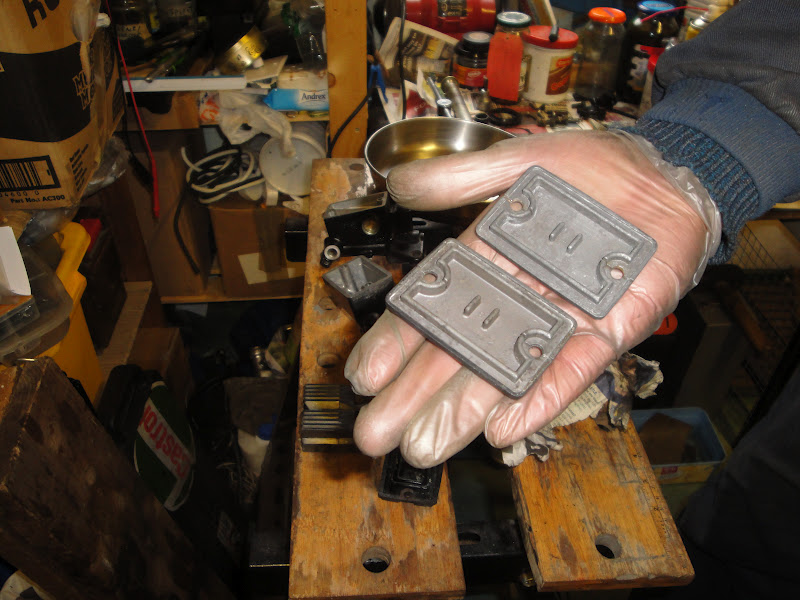
Two reservoir caps are pictured because I cleaned up and lubricated the front brake master cylinder at the same time. I rubbed back the reservoir caps with a plastic alternative to wire wool made by the Scotch company and wiped them down with white spirit. After it has dried off completely, I treated the caps to a coat of Hammerite direct-to-galvanized black paint. 


The master cylinder pistons for clutch and front brake are rather different. The clutch piston return spring is heavier than the one of the brake. The piston for the clutch is operated via a short rod that fits into a recess in the end of the piston and a small boss in the clutch lever. The piston for the brake is acted on directly by the front brake lever. 
Master cylinder pistons for clutch (pictured left) and front brake (pictured to the right)
The pictures below show the cleaned and reconstructed clutch master cylinder. The piston is retained by a washer and an internal circlip. It was a bit awkward replacing the circlip for the clutch - very awkward for the brake because the end of the piston is bigger so there was less room in the bore for my circlip pliers. 

I'd bought a complete set of stainless steel Hel hydraulic lines for the bike. I'd asked for later spec lengths for front brake and clutch to allow for the fitting of higher handlebars, should I decide to go for a more relaxed riding position at some point.

I'd wondered how much heavier the braided lines would be than the standard rubber hoses - so I put them in an old kitched scales to find out. I was amazed to see that the Hel clutch line was actually a lot lighter than the rubber hose, despite being longer. Well well.

 The clutch slave cylinder was treated to a coat of high temperature paint and the piston, return spring and hydraulic seal all carefully cleaned off ready for refitting.


The clutch lever itself had worn considerably at the pivot point. The alloy leaver has a bush pressed in to its pivot point cope with the mechanical torsion of operation. It had both worn and apparently spread into the alloy of the lever body. I've got a pattern replacement on order but would like to see if I can refurbish this one by sourcing and bronze or brass bush, drilling out the pivot point and pressing in a replacement.