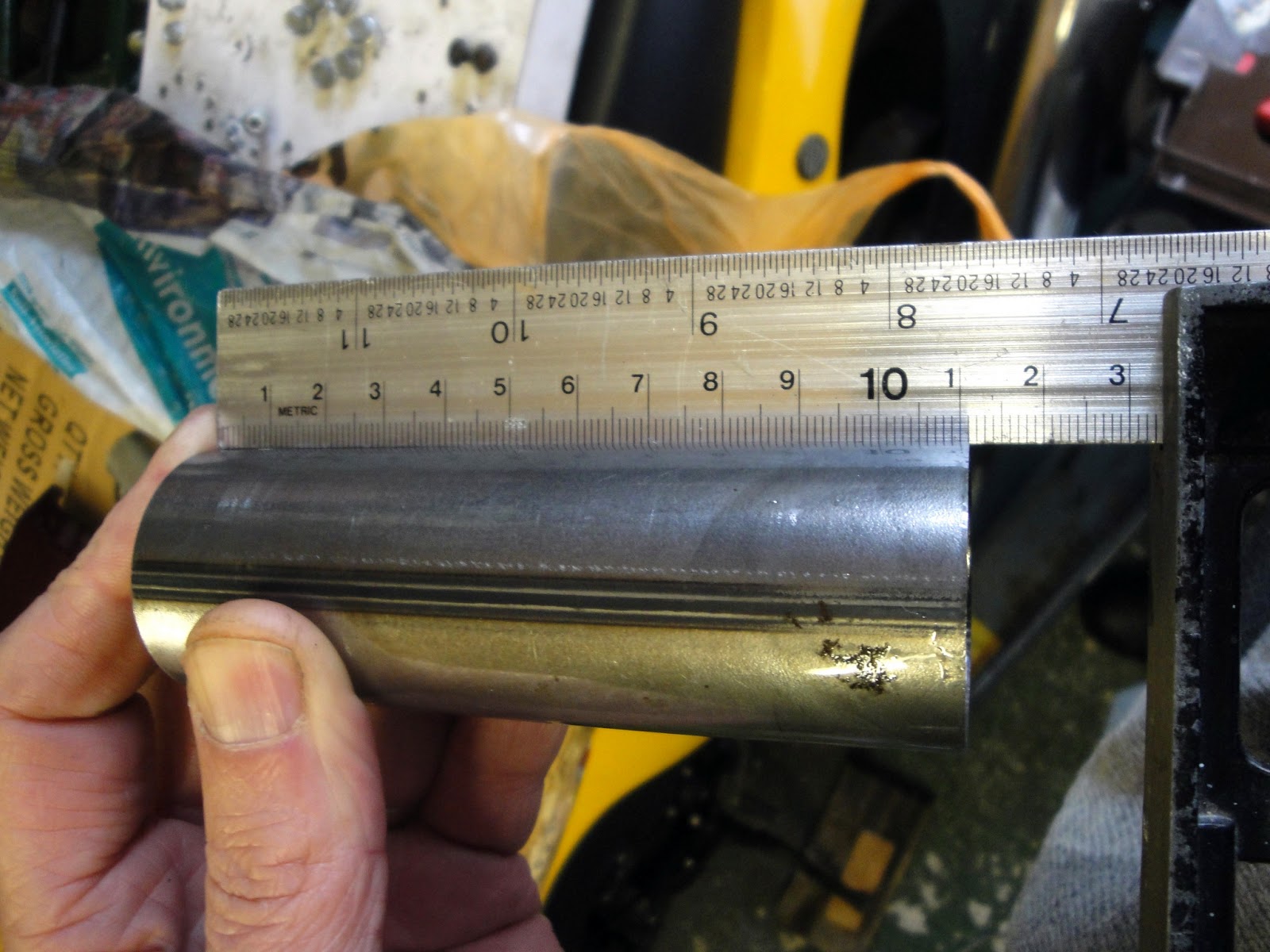
When I fitted stiffer fork springs, I noticed that the unloaded length of the new springs was 490mm. That was 20mm longer than the ones then installed (470mm). This meant that the new springs would be preloaded by the existing spacers quite a lot more than the springs I took out. At the time, I decided to leave it that way to see how things went. After about 900 miles since the rebuild, I've come to the conclusion that there is too little initial movement in the forks and the front ride height could be lower. It feels as though I'm not getting the most out of what the forks can offer to ride quality. I measured the static sag (how much the forks compress when off the stand) and found it hardly moved. The full 145mm stroke dipped hardly at all - too little to measure reliably though I think about 20mm. I think the ideal figure is said to be around 30% with rider on board (hence difficulty in measuring!), though opinions vary.

With the front wheel jacked off the ground, I removed the fork top caps and measured how far the original spacer tubes came up above the stanchion for reference. It was about 31mm. Add that to the threaded length of the top nuts and it means the springs were compressed about 50mm at zero loading, which is about 10%, compared to about 5% for the old springs.
 |
| Original steel spacer tubes are 110mm long |
The
original spacers are 110mm long. I decided to reduce the length of the spacers in the fork legs by
20mm to compensate for the longer length of my replacement springs but I didn't want to cut the originals up. I had
some spacers left over from an Ohlins kit I'd used on my Daytona and decided to cut them down for this application instead.
The Ohlins spacer tubes are made of an aluminium alloy, rather than the steel ones fitted to the Trophy, and they were of a smaller external diameter. That meant there was a risk that they would not seat neatly against the fork top caps or on the spring seats. As it happens, the forks have a spring seats that fits between the top of the springs and the bottom of the spacer tube. It has a lip that by coincidence fitted neatly inside the Ohlins tubes. So the lower end of the spacer wasn't a problem. It wasn't as easy to be sure about this for the upper end of the tube, where it buts up against the fork top cap.
 |
| Measuring up some aluminium disks as seats of the spacer tubes |
|
I made a couple of disks from 1mm aluminium sheet to serve as seats for the top of the new spacer tubes and then cut the Ohlins spacers down to just under 86mm, allowing for the thickness of these disks and also with the idea that I could add extra disks in progressively to vary the preload more easily in the future.
 |
| Shortened alloy spacer tubes and seats |
With the shortened spacers fitted, I checked how much they protruded from the unloaded fork tubes: the answer was 8mm, so I had reduced the preload by 23mm. The disks and caps went on a treat afterwards.The suspension immediately felt more compliant, pumping the forks up and down with the front brake held on. The ride tomorrow will give me a better idea still.


 I decided to use o-rings to keep them centralized in the fork tube. I
bought a Hilka O-ring kit some time ago and it included some that were
just right.They made the spacers a snug fit in the stanchions so I have better confidence the forces will be centralized and distributedevenly.